


“How do I start if I don’t have social proof or a portfolio?”
I get asked this all the time by aspiring freelancers and solopreneurs.
No portfolio → no clients → no portfolio.
So they wait.
Maybe apply for a couple of projects and hope someone takes a chance on them.
You know. I know. That’s not how to build a profitable and sustainable business.
Whether you’re starting from zero or leveling up what you’ve got, this is the fastest path to building a portfolio and proof clients care about.
Keep reading and steal my 7-day portfolio sprint.
👀 "7-Day Portfolio Sprint" Explained
Every job brief or post is a confession.
A potential client is admitting:
What they need
How they describe it
What they’re willing to pay
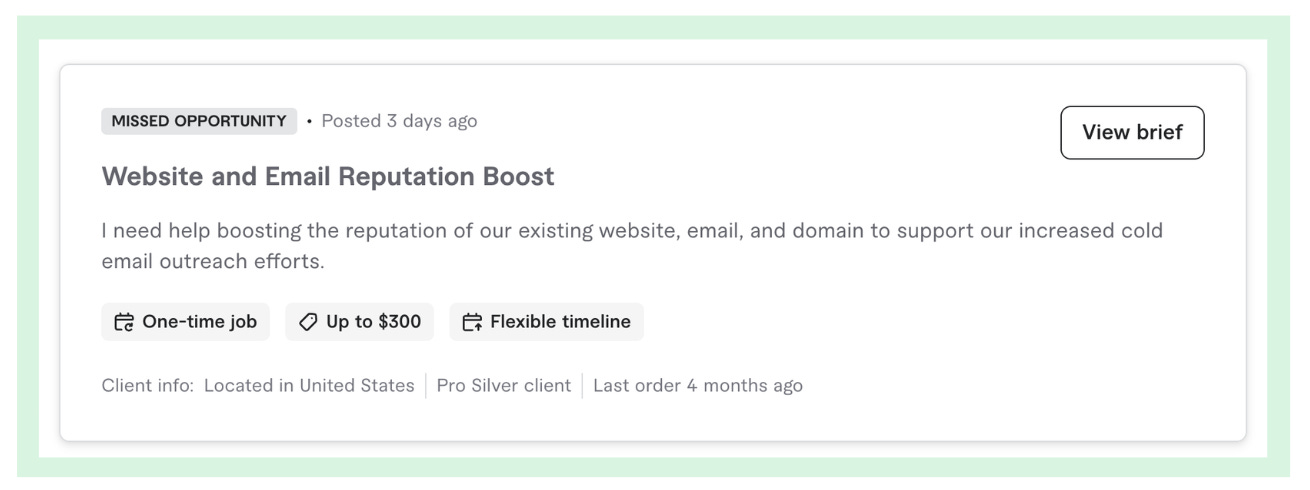
That’s market research most people pay consultants for and it’s sitting on platforms like Upwork, LinkedIn, and Fiverr for free.
The key to a successful sprint is:
Picking a brief that fits your niche and offer
Building the deliverable as if you won the job (adjust the details)
Adding to your portfolio and talking about it on socials
👉 Why a sprint works better than random “practice projects”?
The portfolio sprint means you’re building what the market already wants.
Your samples will speak to the deliverables the client is looking for
(Not what you THINK they’re looking for)
And when you apply for similar gigs, your portfolio speaks the clients language.
This is what makes the difference.
The client doesn't have to imagine what the work might look like… they can see it.
They don't have to wonder if this person understands their industry… the proof is right there.
🚀 Your 7-Day Portfolio Sprint
🔍 Day 1: Search for the brief
Scan platforms like Upwork, Fiverr and LinkedIn for a job post in your niche with clear deliverables.
”I need some writing stuff, will discuss details later” is a cry for help, and you should keep scrolling.
The brief needs to be specific like this example:
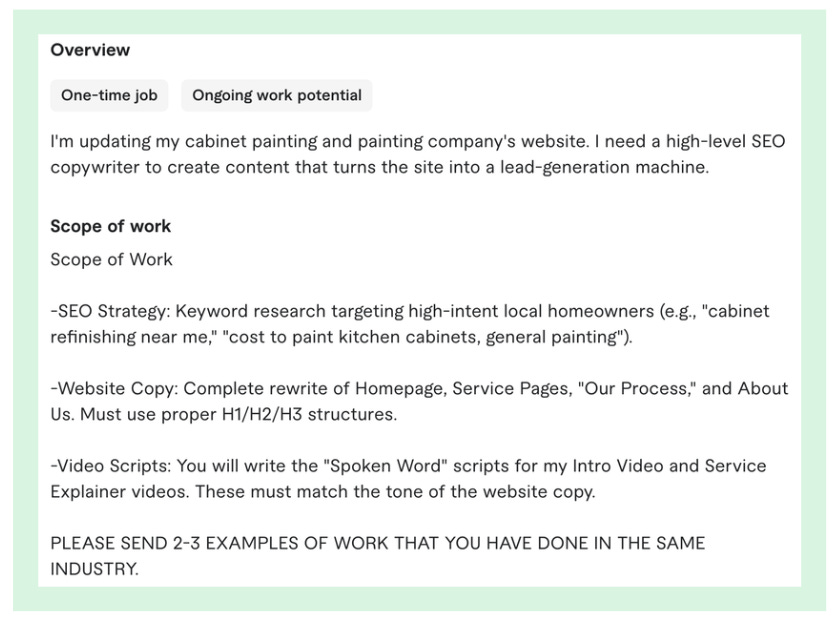
Save the brief. Steal the language. The way clients describe what they want? That’s going straight into your portfolio descriptions and proposals.
🧱 Day 2-4: Build the thing
Create the deliverable as if you landed the job. Change the company name, tweak the industry, make it yours.
Don’t spend three weeks “perfecting” a sample and end up with nothing to show.
Spread it across a few days if you need to. But cap yourself at 90 minutes per day total.
Done beats perfect.
A finished B+ sample will outperform an imaginary A+ masterpiece every single time.
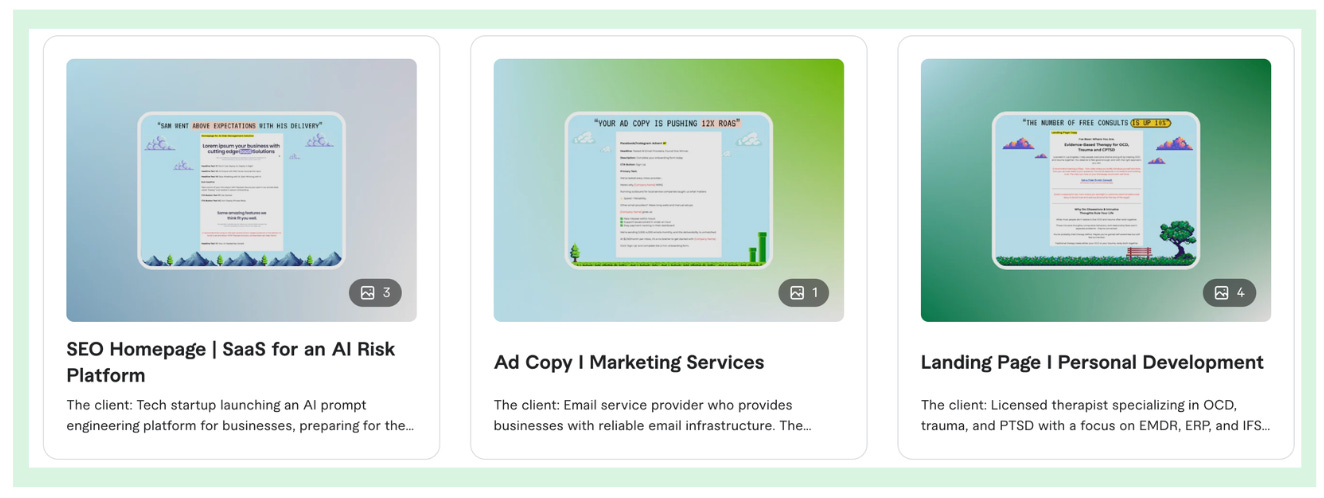
✏️ Day 5: Write your mini case study
Show a quick breakdown:
What was the brief asking for?
How did you approach it?
What problem does this solve?
Congrats, you just turned a random sample into a story which works for your portfolio, social posts, and for proposals when clients ask “walk me through your process.”
Three birds, one stone, zero clients required.
✅ Day 6: Add it to your portfolio
Upload it to your Fiverr gig, Upwork profile, personal site, wherever you live online.
PRO TIP: title your samples the way clients think.
❌ “Brand Messaging Project”
*(What does this even mean? Who is this for? Why should I care?)*
✅ “Website Copy for a Fitness Coach Launching an Online Program”
*(Oh, I’m a fitness coach launching an online program. This is for me.)*
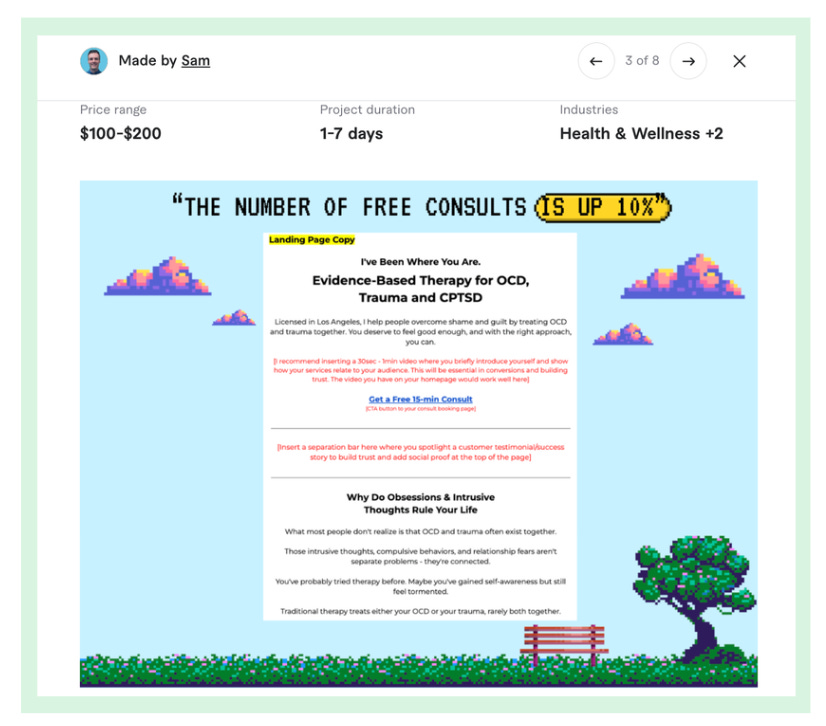
🌍 Day 7: Share it publicly
Post your sample on LinkedIn or X. Show your work. Explain your thinking.
Copy this:
*”Found this brief on [platform] for a SaaS landing page. Loved the challenge, so I built it anyway. Here’s what I came up with → [link]. If you’re working on something similar, I’d love to help out.”*
People see themselves in the work, send you a DM, and your wake up to inbound leads instead of rejections.
(there’s no better feeling! 👌)
💡 Your Friday takeaway
Steal this 7-day portfolio sprint and make your portfolio a living experiment instead of a graveyard of old work.
You can repeat this sprint over and over again.
The more sprints you do the more proof you create and the bigger your personal brand becomes.
That’s how you win in 2026.
See you next week 🚀
Sam
P.S. Missed my post about hitting $589K as a freelancer? Check it out below.

—If you enjoyed issue #25, please tap the Like button below 💙 Thank you!
This is such a hidden gem - yes for finding out what clients are seeking, from their lens, but also from someone that doesn't know exactually what they want to do - it's a great way to "try" out a a project and see, for me, if that is the path I want to go down.